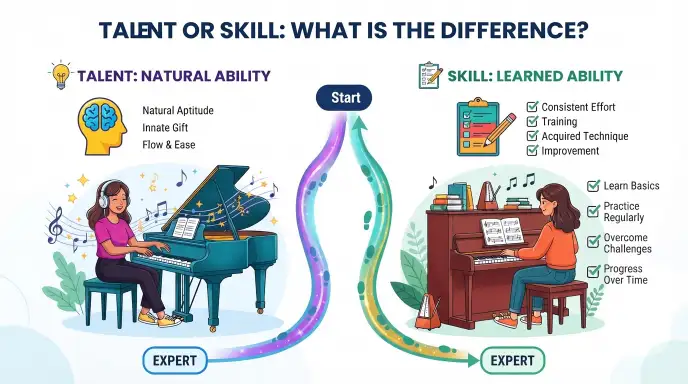
Talent and skill are related, but they are not exactly the same. Talent usually refers to a natural ability that makes a person good at something, while a skill is an ability that is developed through learning, practice, and experience.
For example, someone may have a natural talent for music, but they still need to practice an instrument to become a skilled musician.
In the same way, a person may not have an obvious natural talent for writing but can become a strong writer through study and regular practice.
This difference can be confusing because both words describe what a person can do well. The key is to think about where the ability comes from. Talent is often associated with natural potential, while skill is built over time.
Talent or Skill: Quick Answer
Talent is usually a natural ability or strong potential for doing something well. Skill is an ability that a person develops through learning, practice, training, and experience.
For example:
- A child may have a talent for drawing.
- An artist develops skill by practicing techniques.
- A person can have both talent and skill in the same area.
- Talent can give someone a natural advantage, but skill requires development.
In simple terms, talent is natural ability, while skill is learned ability.
What Does Talent Mean?
Talent is a natural ability or strong aptitude for a particular activity. A talented person may find certain tasks easier to learn or perform than others.
Talent can appear in many areas, including:
- Music
- Writing
- Art
- Sports
- Mathematics
- Communication
- Leadership
- Problem solving
- Acting
- Creativity
For example:
Maya has a talent for painting.
This suggests that Maya has a natural ability or unusual potential in painting.
Talent does not always mean that someone is already highly skilled. A person can have natural potential but still need training and practice to develop it.
Talent in Everyday Use
The word talent is often used when talking about something a person seems naturally good at.
For example:
Daniel has a talent for explaining difficult ideas.
This does not necessarily mean Daniel has had formal training. It suggests that explaining ideas comes naturally to him.
Another example:
She discovered her talent for singing at a young age.
The sentence suggests that singing appeared to be a natural strength.
What Does Skill Mean?
A skill is an ability that a person learns or improves through practice, education, training, or experience.
Skills can be developed in almost every area of life.
Examples include:
- Typing
- Cooking
- Driving
- Coding
- Public speaking
- Editing
- Playing an instrument
- Project management
- Negotiation
- Graphic design
For example:
He developed strong writing skills through years of practice.
The focus here is on development. The ability became stronger through effort and experience.
A skill does not require natural talent. With enough time, instruction, and practice, many people can become skilled at something that did not come naturally to them at first.
Talent vs Skill: The Main Difference
The simplest difference is the source of the ability.
| Talent | Skill |
| Often natural | Usually learned |
| May appear early | Develops over time |
| Gives potential | Shows developed ability |
| Does not require training to exist | Requires learning or practice |
| Can make learning easier | Comes from repeated effort |
| May need development | Can be improved with practice |
Consider a person who has a natural ear for music. That may be a talent.
If the same person learns music theory, practices an instrument, and performs regularly, those abilities become skills.
Talent can help, but skill turns potential into performance.
Talent and Skill Together
Talent and skill are not opposites. In many cases, they work together.
A person may have natural talent in a particular area and then develop that talent through practice.
For example:
Sarah has a natural talent for photography, but she has developed her technical skills through years of practice.
Her talent may have helped her notice composition, lighting, or visual details. Her skills came from learning how to use a camera, edit images, and work with different techniques.
This is why a talented person is not always the best performer. Someone with less natural ability can sometimes become more successful through consistent practice and training.
Can Talent Be Learned?
Talent itself is usually described as a natural ability, so it is not normally something that is simply learned.
However, people can discover, develop, and strengthen their talents.
For example, a child may show a natural interest in drawing. With instruction and practice, that natural ability can develop into advanced artistic skills.
So it is useful to think of talent as potential rather than a finished ability.
Talent may provide the starting point. Skill develops the ability.
Can Skill Become Talent?
People sometimes say that someone has a “talent” for something after seeing how good they have become.
For example:
He has a real talent for cooking.
This may refer to natural ability, but it can also be a compliment based on the person’s impressive performance.
In everyday language, talent can therefore be used more loosely than skill. The exact meaning depends on context.
Talent vs Skill in Different Situations
The two words can appear in many settings, but their emphasis may change.
In Education
Teachers may talk about a student’s talents and skills.
For example:
The student shows a talent for mathematics.
This suggests natural potential.
Meanwhile:
The student has strong mathematical skills.
This focuses on demonstrated ability.
In the Workplace
Employers often look for both natural strengths and developed skills.
For example:
The company is looking for talented designers with strong technical skills.
Here, talent suggests ability or potential, while skills refers to specific abilities needed for the job.
In Sports
A young athlete may have natural talent, but professional performance requires extensive training.
For example:
The player has great natural talent but needs to improve his defensive skills.
This clearly shows the difference between potential and developed ability.
In Creative Work
Artists, writers, musicians, and actors are often described as talented.
However, professional creative work also depends heavily on learned skills.
A talented writer still needs skills in grammar, structure, research, editing, and storytelling.
Which Word Should You Use?
Choose the word based on what you want to emphasize.
Use talent when you mean:
- Natural ability
- Strong potential
- A natural gift
- An ability that seems to come easily
Use skill when you mean:
- Learned ability
- Training
- Practice
- Experience
- A specific ability someone has developed
Compare These Sentences
Emma has a talent for drawing.
This suggests drawing comes naturally to Emma.
Emma has strong drawing skills.
This suggests Emma has developed the ability to draw well.
Both sentences can be true at the same time.
Common Mistakes
Mistake 1: Assuming Talent Means Perfect Ability
Talent does not mean that someone is automatically an expert.
Better understanding:
Talent can give someone natural potential, but practice is still important.
Mistake 2: Thinking Skills Are Always Natural
A skill is generally something that develops through learning and experience.
For example:
He learned the skill of public speaking.
This emphasizes development rather than natural ability.
Mistake 3: Treating Talent and Skill as Exact Synonyms
The words overlap, but they have different shades of meaning.
Talent focuses more on natural ability.
Skill focuses more on developed ability.
Mistake 4: Believing Talent Is More Important Than Skill
Natural ability can help, but it does not replace practice.
Someone with moderate natural ability and strong discipline may become more capable than someone with greater talent who never practices.
Memory tip:
Think of talent as potential and skill as developed ability.
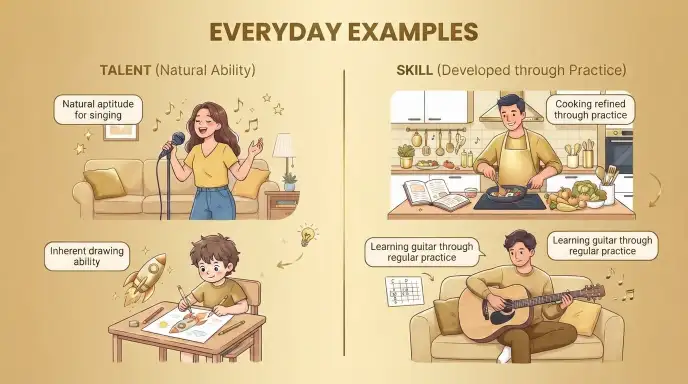
Everyday Examples
Example 1: Music
James has a talent for playing the piano.
He appears to have a natural ability.
James has excellent piano skills.
He has developed his ability through learning and practice.
Example 2: Writing
Maria has a talent for storytelling.
Storytelling seems to come naturally to her.
Maria has strong writing skills.
She has developed the techniques needed to write effectively.
Example 3: Sports
The young player has natural talent.
This refers to potential.
The young player has excellent shooting skills.
This refers to a specific ability developed through training.
Example 4: Cooking
Alex has a talent for creating new recipes.
This suggests natural creativity.
Alex has strong cooking skills.
This suggests learned and practiced abilities.
Example 5: Communication
She has a talent for making people feel comfortable.
This describes a natural strength.
She has excellent communication skills.
This describes a developed ability that can include listening, speaking, writing, and presentation.
Talent vs Skill in Professional Writing
The difference becomes especially useful when writing resumes, job applications, and professional profiles.
Employers often want to know what you can actually do. For this reason, skills are usually listed as specific abilities.
For example:
- Project management
- Data analysis
- Customer service
- Communication
- Graphic design
- Programming
The word talent can be useful when describing a person’s natural strengths or creative abilities.
For example:
She has a natural talent for building strong client relationships.
However, a resume should usually focus on demonstrated skills and achievements rather than simply claiming talent.
Quick Comparison Table
| Word | Basic Meaning | Usually Developed? | Example |
| Talent | Natural ability or potential | Not necessarily | He has a talent for music. |
| Skill | Learned or developed ability | Yes | He has strong musical skills. |
Talent, Skill, Ability, and Expertise
These four words are related, but they are not identical.
| Term | Main Idea | Example |
| Talent | Natural potential | She has a talent for art. |
| Skill | Developed ability | She has excellent drawing skills. |
| Ability | General capacity to do something | She has the ability to learn quickly. |
| Expertise | Advanced knowledge and skill | She has expertise in digital illustration. |
This distinction can make your writing more precise.
If you are describing natural potential, talent is often the better choice.
If you are describing something learned through practice, skill is usually more accurate.
Does Talent Matter More Than Skill?
Not necessarily.
Talent can provide an advantage, especially when someone begins learning a new activity. However, skill grows through practice, feedback, education, and experience.
A talented beginner may perform well early on, but long term success often depends on how consistently the person develops their abilities.
For example, a naturally talented musician still needs to practice regularly. Without practice, that talent may never develop into professional level skill.
This is why talent and skill are often best viewed as connected rather than competing ideas.
How to Develop a Talent Into a Skill
If you believe you have a natural talent for something, practice can help turn that potential into a reliable skill.
A simple process is:
- Identify your natural strength.
- Learn the basics.
- Practice regularly.
- Get useful feedback.
- Study more advanced techniques.
- Use the skill in real situations.
- Keep improving over time.
For example, a person with a natural talent for writing can develop strong writing skills by reading widely, practicing regularly, studying grammar, and learning how to edit their work.
Key Takeaways
- Talent usually refers to natural ability or potential.
- Skill usually refers to an ability developed through learning and practice.
- A person can have both talent and skill.
- Talent does not automatically make someone an expert.
- Skills can be developed through training and experience.
- Talent may provide a useful starting point.
- Consistent practice can turn potential into strong performance.
- In professional writing, specific skills are often more useful to describe than general claims of talent.
FAQs
What is the difference between talent and skill?
Talent usually refers to a natural ability or potential, while skill refers to an ability developed through learning, practice, and experience.
A person may naturally be good at something, but they still need to develop specific skills to perform it at a high level.
Is talent better than skill?
No. Talent and skill serve different purposes. Talent may give someone a natural advantage, but skill comes from development and practice. A person with strong skills can often outperform someone with natural talent who does not practice or improve.
Can you have talent without skill?
Yes. Someone can have natural potential without having developed the techniques needed to use it effectively.
For example, a person may have a talent for music but still need lessons and practice to develop strong musical skills.
Can you develop a skill without talent?
Yes. Many skills can be learned through practice, education, training, and experience. Natural talent may make learning easier for some people, but it is not always necessary to become competent or even highly skilled.
Is writing a talent or a skill?
Writing can be both. Some people may have a natural talent for storytelling or expressing ideas, while writing skills such as grammar, structure, editing, and research are developed through learning and practice.
Is communication a talent or a skill?
Communication can be both a natural strength and a learned skill. Some people naturally find it easy to speak with others, while effective communication also involves skills that can be learned, such as listening, presenting ideas, writing clearly, and handling difficult conversations.
What is an example of talent and skill?
A person may have a natural talent for drawing. After years of practice, they may develop strong skills in perspective, shading, composition, and digital illustration.
The talent describes the natural potential, while the skills describe what they have learned to do well.
Are talent and ability the same?
They are closely related, but they are not always identical. Ability can refer broadly to someone’s capacity to do something, while talent often suggests a natural or unusually strong ability in a particular area.
What is more important for success, talent or skill?
Both can matter, but skill is essential because it turns potential into consistent performance. Practice, experience, learning, and persistence can help people develop abilities even when something does not come naturally at first.
How do I know if I have a talent?
A possible talent may show up when you learn something unusually quickly, enjoy an activity naturally, or perform well with relatively little instruction.
However, real improvement still requires practice, so natural ability alone is not enough to judge your long term potential.
Conclusion
Talent and skill are closely connected, but they describe different sides of ability. Talent usually points to something that comes naturally, while skill refers to something that has been developed through learning, practice, and experience.
A person may have a natural talent for music, sports, writing, art, or communication. But talent alone does not guarantee excellent performance. Practice helps turn natural potential into useful and reliable skill.
The distinction is also helpful in everyday and professional writing. Use talent when you want to emphasize natural ability or potential. Use skill when you want to highlight something a person has learned and developed.
The simplest way to remember the difference is: talent is potential, while skill is ability developed through practice.
Read More About!

I’m Taylor Brooks, a grammar enthusiast who loves making English writing clearer, simpler, and more accurate. I create helpful grammar tips and practical tools to make writing with confidence easier for everyone.


2 thoughts on “Talent or Skill: What Is the Difference?”