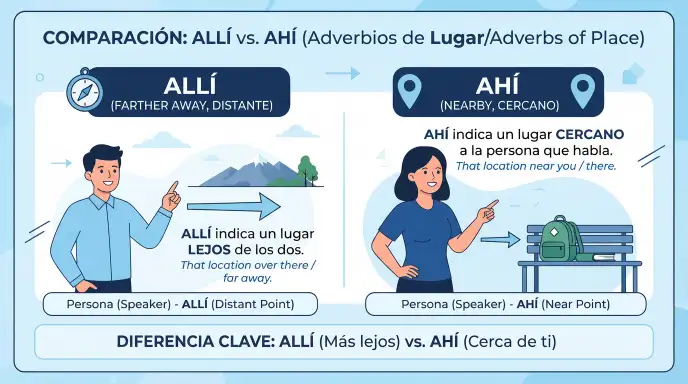
If you are choosing between alli or ahi, both Spanish words can mean “there,” but they usually point to different locations.
The main difference is distance and context. Ahí commonly refers to a place that is near the person being addressed or somewhere at a middle distance, while allí often points to a place that feels farther away. This can be confusing because English normally uses one word, “there,” for both ideas.
Spanish learners often search for alli or ahi because the two words can look and sound similar. They also appear in many everyday sentences, so knowing when to use each one can make your Spanish more natural. The difference is not simply about spelling. It is about how the speaker views the location.
For example, you might say “Pon el libro ahí” when the book is being placed in a spot near the listener.
You might say “La escuela está allí” when talking about a place farther away. The exact choice can depend on context and how the speaker views distance.
Alli or Ahi :Quick Answer
Ahí and allí both commonly translate as “there,” but they are not always used in the same way.
- Ahí = there, often near the listener or at a middle distance.
- Allí = there or over there, often referring to a more distant place.
Examples
- El teléfono está ahí. :The phone is there.
- La estación está allí. :The station is over there.
- Quédate ahí. :Está allí.
- Mi casa está allí. :My house is over there.
The difference is about location and perspective rather than a simple spelling rule.
Definition and Meaning of Alli or Ahi
What Does Ahí Mean?
Ahí is a Spanish adverb used to point to a location. It can refer to something near the listener or to a place at a middle distance.
For example:
Tu libro está ahí.
This means:
Your book is there.
Ahí can also appear when giving instructions:
Pon la taza ahí.
This means:
Put the cup there.
The exact distance depends on the situation. Modern Spanish usage does not always follow one strict distance rule.
(What Does Allí Mean?
Allí is also an adverb that refers to a location. It is often translated as “there” or “over there.”
For example:
La tienda está allí.
This means:
The store is over there.
Allí often suggests that the place is farther from the speaker and listener than the location described with ahí. However, the distinction can be subjective and depends on context.
Why Are They Confusing?
The confusion comes from English. English normally uses “there” for both ideas. Spanish gives speakers several choices for location, including aquí, ahí, allí, and allá.
A simple way to remember the basic contrast is:
aquí → ahí → allí → allá
This represents a general movement from closer to farther away, although real Spanish usage can be more flexible.
The Origin of Alli or Ahi
Ahí and allí belong to the Spanish system of locational adverbs. They are part of a larger group that includes aquí, acá, allí, and allá.
Traditional descriptions connect these words with location and distance. In this system, aquí generally refers to a place near the speaker, ahí often refers to an intermediate location, and allí refers to a more distant location.
The accent marks are also important. The standard forms are:
- ahí
- allí
Writing ahi or alli without the accent may appear in informal typing, but standard Spanish spelling uses the accent marks.
Research on Spanish conversation also shows that the difference is not always rigid. A corpus study of Colombian Spanish found that ahí was much more frequent than allí, and that ahí can extend beyond a simple physical-distance meaning.
Spanish Usage: Alli vs Ahi
Unlike English, Spanish can express different ideas of location through several words.
| Spanish word | Basic English meaning | General idea |
| aquí | here | Near the speaker |
| ahí | there | Near the listener or middle distance |
| allí | there / over there | Farther away |
| allá | over there | Often a more distant or general area |
These are useful guidelines, not absolute rules. Context and the speaker’s perspective can affect the choice.
Which Spelling Should You Use?
If you mean the Spanish word for a location, use the form that fits your intended meaning:
- Use ahí when referring to a place near the listener or a location viewed as relatively close.
- Use allí when referring to a place that is farther away.
- Use aquí for something near the speaker.
- Use allá when referring to a more distant or general area.
If you are writing for Spanish learners, adding the accent marks is important. Write ahí, not ahi, and allí, not alli, in standard Spanish.
The most important point is that ahí and allí are both correct words. One is not simply a misspelling of the other.
Common Mistakes with Alli or Ahi

1. Treating Ahí as a Misspelling of Allí
This is one of the most common mistakes.
Incorrect idea:
Ahí is just a shorter version of allí.
Correct:
They are separate Spanish words with related meanings.
2. Removing the Accent
Standard spelling uses:
- ahí
- allí
The accent is part of the written form.
3. Using Only Distance as a Fixed Rule
It is useful to learn that ahí is generally closer and allí is generally farther. However, this should not be treated as an exact measurement.
Spanish speakers may choose a word based on their perspective and the context.
4. Translating Both Words the Same Way Every Time
Both words can mean “there” in English, but their Spanish usage can differ.
Instead of memorizing only the English translation, learn each word with example sentences.
Alli or Ahi in Everyday Examples
In Conversation
Ahí está tu mochila.
Your backpack is there.
Allí está la entrada.
The entrance is over there.
In Instructions
Ponlo ahí.
Put it there.
Mira allí.
Look over there.
In Questions
¿Qué haces ahí?
What are you doing there?
¿Quién vive allí?
Who lives there?
In Travel
El hotel está allí.
The hotel is over there.
¿Hay una farmacia ahí?
Is there a pharmacy there?
In Formal Writing
Both words can appear in formal Spanish when the writer needs to identify a location.
For example:
La oficina se encuentra allí.
The office is located there.
The correct choice depends on the location being described and the writer’s perspective.
Alli or Ahi :Google Trends & Usage Data
Search interest for alli or ahi reflects a common Spanish-learning question: learners want to understand why two words can both translate as “there.”
Available language research shows that the two forms are not equally common in every variety of Spanish.
A corpus study of Colombian conversation found around 400 occurrences of ahí, compared with only 42 occurrences of allí in the analyzed corpus. The study also found that ahí was used in broader ways than a simple distance marker.
This means learners should not assume that the textbook distance rule works identically in every Spanish-speaking region.
For practical learning, focus on the common contrast:
Ahí = there / right there
Allí = there / over there
Then pay attention to how native speakers use these words in real sentences.
Alli or Ahi Comparison Table
| Feature | Ahí | Allí |
| Basic meaning | There | There / over there |
| Word type | Adverb | Adverb |
| Common use | Location near the listener or at a middle distance | Location viewed as farther away |
| Accent | Required in standard spelling | Required in standard spelling |
| English equivalent | There | There / over there |
| Example | Está ahí. | Está allí. |
| Main idea | Relatively closer | Relatively farther |
The distinction is useful, but it is not an exact distance measurement. Context and speaker perspective matter.
FAQs About Alli or Ahi
1. Are ahí and all the same?
They can both mean “there,” but they are not always interchangeable. Ahí often points to a location closer to the listener or at a middle distance, while allí often points to a more distant location.
2. Is alli correct without an accent?
In standard Spanish, the correct spelling is allí, with an accent on the final í.
3. Is ahi correct without an accent?
The standard spelling is ahí, with an accent on the final í.
4. Which is closer, ahí or allí?
As a general guideline, ahí is closer than allí. However, the distinction depends on context and the speaker’s perspective.
5. Can ahí and allí both mean “there”?
Yes. Both can be translated as “there” in English. The Spanish choice gives more information about the location and perspective.
6. What is the easiest way to remember ahí and allí?
Think of ahí as “there” and allí as “over there.” This is a simple learning guide, although actual usage can vary.
7. Are ahí and allí used in everyday Spanish?
Yes. Both are Spanish location words used in everyday speech and writing. Research also shows that their frequency can vary by Spanish-speaking region.
Conclusion
When deciding between alli or ahi, remember that both are correct Spanish words, but they often describe locations from different perspectives.
Ahí commonly refers to a place near the listener or at an intermediate distance, while allí often points to a place that feels farther away.
Both words can translate as “there,” which is why English speakers may find the difference difficult at first.
The accent marks also matter. In standard Spanish, write ahí and allí. Do not treat one as a misspelling of the other. They are separate adverbs with their own uses.
A useful learning pattern is aquí, ahí, allí, allá, moving from closer to farther locations. Still, do not treat this pattern as an exact measurement. Spanish speakers can choose between ahí and allí based on context, perspective, and regional usage.
For everyday Spanish, start with clear examples. Use ahí for “there” when the location feels relatively close, and allí for “over there” when it feels farther away. With regular practice, the difference becomes much easier to recognize.
More Related Slang!

I’m Taylor Brooks, a grammar enthusiast who loves making English writing clearer, simpler, and more accurate. I create helpful grammar tips and practical tools to make writing with confidence easier for everyone.







2 thoughts on “Alli or Ahi: Which Spanish Word Should You Use?”