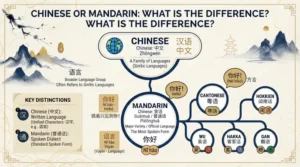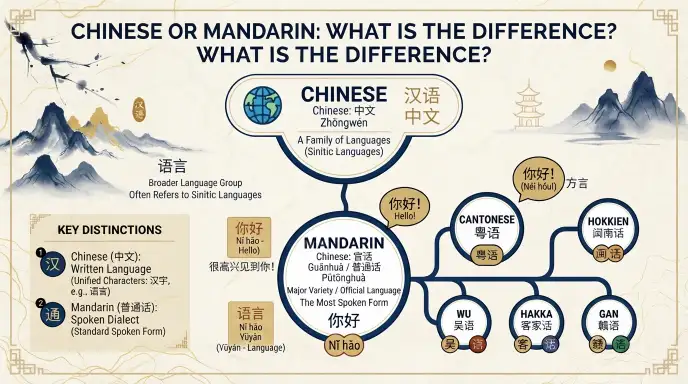
Chinese is a group of languages and varieties, while Mandarin is the most widely spoken form of Chinese and the official language of China and Taiwan.
Many people use “Chinese” and “Mandarin” as if they mean the same thing, but the two terms are not exactly interchangeable.
Understanding the difference can make conversations about language, culture, writing, and learning much clearer.
People often search for Chinese or Mandarin because they want to know what to call the language they hear in China, Taiwan, or Chinese speaking communities.
The confusion is easy to understand. Mandarin is Chinese, but Chinese can refer to more than Mandarin alone.
This guide explains the meaning of both terms, their relationship, pronunciation, writing systems, regional use, and common mistakes.
It also gives simple examples to help you choose the right word in everyday conversation, schoolwork, travel, and language learning.
Chinese or Mandarin: Quick Answer
Chinese is a broad term that can refer to the Chinese language family, Chinese varieties, or the written language. Mandarin is a specific major variety of Chinese.
For example:
- Mandarin is a type of Chinese.
- Cantonese is also a variety of Chinese.
- A person may say they are learning Chinese when they specifically mean Mandarin.
- If you want to be precise about the spoken language, “Mandarin” is often the clearer term.
The exact meaning of “Chinese” depends on the context.
What Does Chinese Mean?
“Chinese” is a broad word connected to the languages, people, writing, and culture of China and Chinese speaking communities.
When someone says, “I speak Chinese,” they may mean Mandarin. This is very common because Mandarin has a very large number of speakers and is the main language taught to learners around the world.
However, Chinese can also refer to other varieties, including Cantonese, Wu, Min, Hakka, and others.
The word can also describe the written language. Chinese writing uses characters rather than an alphabet like English. Traditional and simplified Chinese are two major forms of written Chinese.
Chinese as a Broad Language Term
In language discussions, “Chinese” can be used as an umbrella term.
For example:
- “I am studying Chinese.”
- “Chinese characters can be difficult for beginners.”
- “She enjoys Chinese literature.”
- “Chinese is widely studied around the world.”
In the first sentence, the speaker may actually be studying Mandarin. The broader word is still commonly used.
Chinese in Everyday Conversation
In casual speech, people often say “Chinese” instead of “Mandarin” because it is easier and more familiar.
For example:
“Do you speak Chinese?”
The speaker may simply want to know if someone can communicate in Mandarin. The question does not always mean that they are asking about every Chinese variety.
What Does Mandarin Mean?
Mandarin is a major group of Chinese varieties. Standard Mandarin is based mainly on the Mandarin spoken in northern China, with pronunciation standards associated with Beijing.
In mainland China, Standard Mandarin is known as Putonghua, meaning “common language.” In Taiwan, the standard form is commonly called Guoyu, meaning “national language.”
Mandarin is also widely spoken in Singapore and by Chinese communities around the world.
For a language learner, “Mandarin” usually means the standard spoken form used in education, media, government, and many everyday situations.
Mandarin and Tones
One important feature of Mandarin is its use of tones.
A change in tone can change the meaning of a syllable. This is one reason Mandarin pronunciation can feel different from English pronunciation.
Learners often practice four main tones plus a neutral tone. Tone practice is important because saying the correct sounds with the wrong tone can produce a different word.
Mandarin Examples
Here are a few familiar Mandarin words:
- Nǐ hǎo = Hello
- Xièxie = Thank you
- Zàijiàn = Goodbye
- Shì = Is / yes
- Bù = No / not
These words are written in Chinese characters as well as Romanized forms called Pinyin.
The Origin of Chinese and Mandarin
The history of China is very old and developed over many centuries.
Written Chinese has a long recorded history, with early forms of Chinese characters appearing in ancient inscriptions. Over time, the writing system developed into the character forms used today.
Spoken Chinese also changed across different regions. Because China covers a large geographic area, communities developed different speech varieties over time.
Mandarin developed from northern Chinese speech varieties. Later, forms of Mandarin became increasingly important for administration, education, and national communication.
Standard Mandarin was established as a national standard in the modern period. Today, it is the main spoken standard used in mainland China.
The relationship between Chinese and Mandarin is therefore partly a matter of scope. Chinese is the broader term, while Mandarin identifies a particular major variety.
Chinese vs Mandarin: British English vs American English
The Chinese Mandarin distinction is different from the difference between British and American English.
British English and American English are varieties of the same language, while Mandarin is one major variety within the broader group commonly called Chinese.
| Term | What It Refers To | Example |
| Chinese | Broad language term | “I am learning Chinese.” |
| Mandarin | Specific Chinese variety | “I am learning Mandarin.” |
| Cantonese | Another major Chinese variety | “He speaks Cantonese.” |
| Standard Mandarin | Standardized form of Mandarin | Used in education and official communication |
There are also regional differences in pronunciation, vocabulary, and grammar among Chinese varieties.
For this reason, the word “Chinese” does not always tell you exactly which spoken variety someone uses.
Which Version Should You Use?
The best term depends on what you want to say.
United States
In the United States, “Chinese” is very common when discussing the language in general. If you specifically mean the spoken language used in mainland China, Taiwan, or many international learning programs, Mandarin is more precise.
For example:
- General: “I am taking a Chinese class.”
- Specifically: “I am taking a Mandarin class.”
Both can be natural, but the second gives more information.
United Kingdom
British English speakers also commonly use “Chinese” as a broad term and “Mandarin” for the specific spoken variety.
If a course teaches Mandarin, the course title may simply say “Chinese,” especially when Mandarin is the expected standard.
Canada
In Canada, both terms are used. “Chinese” can describe the broader language or cultural context, while “Mandarin” identifies a specific spoken variety.
Australia
Australian speakers may also use “Chinese” when talking generally about the language. “Mandarin” is useful when distinguishing it from Cantonese or other varieties.
International Writing
For international readers, Mandarin is often the clearest choice when discussing the standard spoken language.
Use “Chinese” when your subject includes Chinese writing, Chinese varieties as a group, or Chinese language and culture more generally.
Academic Writing
Academic writing should aim for precision.
If the subject is specifically Mandarin pronunciation, grammar, vocabulary, or speaking, use Mandarin.
If the subject covers several Chinese varieties or the Chinese writing system, Chinese may be more suitable.
Business Writing
Business communication should make the intended meaning clear.
For example:
“Our company offers Mandarin training for employees.”
This tells readers exactly what language is being taught.
By contrast:
“Our company offers Chinese training.”
This is understandable, but it may leave some readers wondering which spoken variety the course covers.
Common Mistakes with Chinese or Mandarin
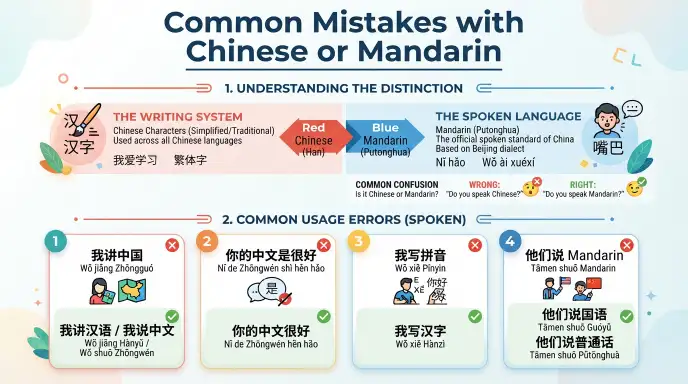
Mistake 1: Treating Chinese and Mandarin as Exact Synonyms
Incorrect idea: Chinese and Mandarin always mean exactly the same thing.
Better: Mandarin is one major variety of Chinese.
Why: “Chinese” can have a broad meaning, while “Mandarin” is more specific.
Memory tip: Think of Chinese as the larger category and Mandarin as one part of it.
Mistake 2: Assuming Everyone in China Speaks Only Mandarin
Mandarin is widely used across mainland China, but China has many regional speech varieties and languages.
People may grow up speaking a local variety at home while also learning Standard Mandarin at school.
Mistake 3: Calling Cantonese Mandarin
Cantonese and Mandarin are different Chinese varieties.
Someone who speaks Cantonese is not automatically speaking Mandarin.
For example, Cantonese is strongly associated with Hong Kong and parts of southern China, while Mandarin has a much wider national role.
Mistake 4: Confusing Pinyin with Chinese
Pinyin is a system used to represent Mandarin pronunciation with Roman letters.
For example:
你好 = Nǐ hǎo
The Chinese characters are 你好. The Pinyin is Nǐ hǎo.
Pinyin helps learners pronounce Mandarin, but it is not a replacement for the Chinese writing system.
Mistake 5: Thinking Traditional and Simplified Chinese Are Different Spoken Languages
Traditional Chinese and Simplified Chinese mainly refer to different character forms used in writing.
They are not simply two different spoken languages.
A person can speak Mandarin and write using either simplified or traditional characters, depending on region, education, purpose, and personal preference.
Everyday Examples
Here are practical examples showing how the two terms work.
In an Email
“I am interested in taking a Mandarin course next month.”
This is useful when you specifically want to learn Mandarin.
In Business Writing
“Our website is available in English, Chinese, and Spanish.”
Here, “Chinese” may describe a language option without specifying the spoken variety.
In a News Headline
“Mandarin Classes Grow in Popularity Among Students”
“Mandarin” clearly identifies the language being taught.
In a Blog
“Chinese characters have a long history.”
Here, “Chinese” is appropriate because the topic is writing.
On Social Media
“I started learning Mandarin this year!”
This is clear when the person means the spoken language.
In Academic Writing
“This paper examines Mandarin pronunciation.”
The specific term is useful because the subject is pronunciation in Mandarin.
In Daily Conversation
“Can you speak Chinese?”
This is common and natural. If you want to know specifically about Mandarin, you can ask:
“Can you speak Mandarin?”
The second question is more precise.
Google Trends & Modern Usage
Searches for “Chinese” and “Mandarin” often come from people who are trying to identify a language, choose a language course, translate something, or understand the difference between Chinese varieties.
The word Chinese has a broad everyday meaning. It may refer to a language, writing system, culture, or something connected with China.
Mandarin is more specific. It is especially common in language learning settings where people need to identify the exact spoken language they are studying.
Modern usage also depends on the setting. A beginner may say “I am learning Chinese,” while a teacher may say “You are learning Mandarin.”
Both statements can describe the same learner.
The main difference is precision, not necessarily correctness.
Quick Comparison Table
| Version | Meaning | Correct? | Common Use | Example |
| Chinese | Broad term for Chinese language varieties or writing | Yes | General discussion | “I study Chinese.” |
| Mandarin | Major Chinese spoken variety | Yes | Specific language discussion | “I speak Mandarin.” |
| Standard Mandarin | Standardized form of Mandarin | Yes | Education and official communication | “The class teaches Standard Mandarin.” |
| Cantonese | Another Chinese variety | Yes | Regional and community use | “She speaks Cantonese.” |
| Pinyin | Romanization system for Mandarin | Yes | Pronunciation and learning | “Nǐ hǎo is written in Pinyin.” |
Chinese and Mandarin in Language Learning
If you are starting a language course, check what the course actually teaches.
A course called “Chinese” may teach Mandarin. This is common in schools, apps, and language programs.
However, some programs may teach Cantonese or another Chinese variety. The course description should tell you which one is included.
For beginners, Mandarin lessons often cover:
- Basic pronunciation
- Tones
- Pinyin
- Common vocabulary
- Sentence patterns
- Chinese characters
- Listening practice
- Everyday conversation
Learning the exact term helps you choose the right course and study materials.
Chinese Characters: Simplified vs Traditional
Another common source of confusion is the difference between simplified and traditional Chinese characters.
Simplified Chinese uses simplified character forms and is widely used in mainland China and Singapore.
Traditional Chinese keeps traditional character forms and is widely used in Taiwan and Hong Kong.
The choice mainly concerns writing. It does not automatically tell you the speaker’s spoken language.
For example, Mandarin can be written with simplified characters or traditional characters.
This means these questions are asking about different things:
- “Do you speak Mandarin?” asks about a spoken variety.
- “Do you read traditional Chinese?” asks about a writing system.
Is Mandarin the Same as Chinese?
Mandarin is not exactly the same as Chinese in every context.
If someone says, “I speak Chinese,” they may mean Mandarin. This is perfectly common in everyday conversation.
But in a detailed language discussion, “Chinese” can include more than Mandarin.
A simple way to remember it is:
Chinese = broad term
Mandarin = specific major variety
This distinction becomes especially useful when discussing Mandarin alongside Cantonese, Hakka, Min, Wu, or other Chinese varieties.
FAQs
Is Mandarin a type of Chinese?
Yes. Mandarin is a major variety within the broader group commonly called Chinese. Standard Mandarin is the standardized form used widely in mainland China and in many educational and international settings.
Should I say Chinese or Mandarin?
Use “Chinese” when speaking generally about the language, writing system, or Chinese varieties.
Use “Mandarin” when you specifically mean the Mandarin spoken language. For language courses, check the course description to see exactly what is taught.
Is Chinese a language or a group of languages?
The word “Chinese” can be used in different ways. In everyday speech, it often refers to a language.
In linguistic discussions, it can refer more broadly to a group of related language varieties.
Is Cantonese Chinese?
Yes. Cantonese is commonly described as a Chinese variety. It is different from Mandarin and has its own pronunciation, vocabulary, and speech traditions.
Is Mandarin spoken only in China?
No. Mandarin is spoken by communities outside mainland China as well. It is also widely used in Taiwan, Singapore, and Chinese speaking communities around the world.
Are Mandarin and Cantonese the same?
No. Mandarin and Cantonese are different Chinese varieties. They differ in pronunciation, vocabulary, tones, and other features.
Is Pinyin Chinese?
Pinyin is a Romanization system used mainly to represent Mandarin pronunciation. It uses Roman letters to show how Mandarin words are pronounced. It is a learning and pronunciation tool, not the same thing as Chinese characters.
Are simplified and traditional Chinese different languages?
No. Simplified and traditional Chinese mainly refer to different forms of written Chinese characters. They are writing conventions rather than two separate spoken languages.
Is Mandarin easier to learn than Chinese?
This question depends on what is meant by “Chinese.” Mandarin is itself a form of Chinese, so comparing Mandarin with Chinese as two separate languages can be misleading.
The difficulty of learning Mandarin depends on the learner’s language background and study methods.
Why do people call Mandarin Chinese?
“Chinese” is a common broad term, and Mandarin is the most widely used standard spoken variety in many contexts. As a result, people often use “Chinese” when they specifically mean Mandarin.
Key Takeaways
- Chinese is a broad term with several possible meanings.
- Mandarin is a major Chinese variety.
- “Chinese” is common in general conversation.
- “Mandarin” is more precise when discussing the spoken language.
- Cantonese is different from Mandarin.
- Pinyin represents Mandarin pronunciation using Roman letters.
- Simplified and traditional Chinese mainly describe written character forms.
- Always check a language course to see which Chinese variety it teaches.
- The right term depends on the context and the level of detail you need.
Conclusion
Chinese and Mandarin are closely connected, but they are not identical terms. Chinese can be used as a broad name for the language and its varieties, while Mandarin refers to one major spoken variety.
For everyday conversation, saying “I am learning Chinese” is common and easy to understand.
If you want to be more specific, especially in education, language study, or academic writing, “I am learning Mandarin” gives readers more information.
The same idea applies to writing. Simplified and traditional Chinese describe character forms, while Mandarin describes a spoken variety.
Pinyin is another separate concept because it helps show Mandarin pronunciation using Roman letters.
The easiest rule to remember is simple: Chinese is the broader term, and Mandarin is a specific variety of Chinese.
Once you understand this difference, it becomes much easier to describe the language you speak, study, teach, or write about.
Use the broader term when the topic is general, and use “Mandarin” when you mean the specific spoken variety.
Learn the Meaning!

I’m Taylor Brooks, a grammar enthusiast who loves making English writing clearer, simpler, and more accurate. I create helpful grammar tips and practical tools to make writing with confidence easier for everyone.