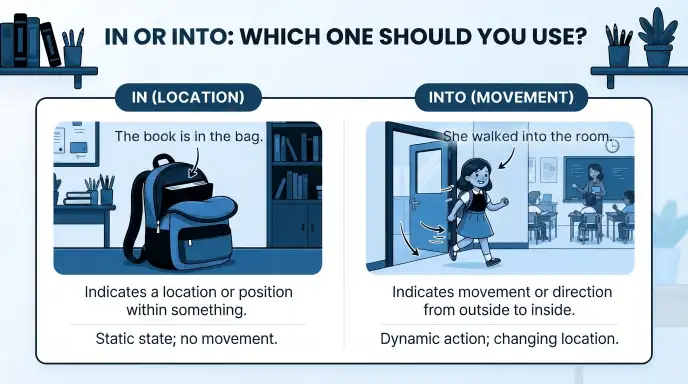
In and into are both correct, but they are used in different ways: “in” usually shows a position, while “into” often shows movement from outside to inside. This small difference can cause confusion because both words can appear with places, rooms, buildings, and containers.
For example, “She is in the room” tells us where she is, while “She walked into the room” tells us that she moved from outside to inside.
People often search for in or into because the two words can seem interchangeable in sentences such as “Put the book in the bag” and “Put the book into the bag.”
In some cases, both forms are possible. In other cases, using the wrong word can change the meaning or make the sentence sound unnatural.
The easiest way to remember the difference is to think about position and movement. Use it when you are describing something that is already inside a place.
Use when you are describing movement toward the inside. Once you understand this basic idea, choosing between them becomes much easier.
In or Into :Quick Answer
Use it to describe a position inside something. Use into to describe movement from outside to inside.
- The children are in the classroom. → They are already there.
- The children walked into the classroom. → They moved from outside to inside.
- The keys are in my bag.
- She put the keys into her bag.
However, some verbs allow both in and without a major change in meaning. For example:
- Put the clothes in the drawer.
- Put the clothes into the drawer.
Cambridge Dictionary explains that in is commonly used for position, while into is commonly used for movement toward the inside.
Definition and Meaning of In or Into
What Does “In” Mean?
In is a preposition that often shows that someone or something is inside a place, area, object, or container.
Examples:
- The phone is in my pocket.
- She is in the kitchen.
- They live in London.
- There is water in the bottle.
It can also be used for time:
- I was born in 2000.
- We will meet in July.
- He finished the work in two hours.
The word in has many other uses, so its meaning depends on the sentence.
What Does “Into” Mean?
Into is a preposition that often shows movement toward the inside of something.
Examples:
- He walked into the room.
- She jumped into the pool.
- Pour the water into the glass.
- The cat ran into the house.
Into can also show a change from one state or form to another:
- The caterpillar changed into a butterfly.
- They turned the garage into an office.
- She translated the book into Spanish.
It can also show strong interest:
- He is into music.
- She is really into photography.
These are established uses of into in English.
The Origin of In or Into
In is an old English word that has been used for many centuries to describe an inside position or location. It developed from older Germanic forms and became a common part of English grammar.
Into developed from the combination of in and to. Its basic idea connects being inside with movement toward an inside place.
The two words are closely related, but English uses them for different ideas. The key difference is not spelling. It is mainly about position versus movement.
British English vs American English Spelling
There is no British versus American spelling difference between in and into. Both forms are standard in British English and American English.
The main difference is how they are used in a sentence.
| Use | British English | American English |
| Position | in | in |
| Movement inside | into | into |
| Already inside | in | in |
| Change or transformation | into | into |
| Interest | into | into |
For example:
- British: She walked into the shop.
- American: She walked into the store.
The words in and into remain the same. Differences may appear in the surrounding vocabulary, but not in the spelling of these two prepositions. Cambridge also describes in and into as prepositions in both varieties of English.
Which One Should You Use?
Choose when you want to show a position or location.
Example:
The children are in the classroom.
Choose when you want to show movement toward the inside.
Example:
The children ran into the classroom.
A simple test can help:
Ask: Is the person or thing already inside?
- Yes → in
- No, it is moving inside → into
There are some exceptions. With verbs such as put, fall, and jump, both forms may sometimes be used.
- Put the cup in the cupboard.
- Put the cup into the cupboard.
Both can be natural, depending on the sentence and style.
Common Mistakes with In or Into
Mistake 1: Using “into” for a fixed position
❌ She is into the room.
✅ She is in the room.
If she is already inside, it is normally correct.
Mistake 2: Using “in” when movement is important
❌ He walked in the house.
✅ He walked into the house.
The second sentence clearly shows movement from outside to inside.
Mistake 3: Confusing “in to” with “into”
Sometimes in and to appear next to each other as separate words.
Example:
She went in to speak with the manager.
Here, in and to have separate roles.
But in:
She went into the office.
Into is one preposition showing movement inside.
Mistake 4: Forgetting the change meaning
Use into when something changes from one form or condition to another.
❌ The artist turned the room in a studio.
✅ The artist turned the room into a studio.
Cambridge lists after verbs that describe change, such as change, turn, and translate.
In or Into in Everyday Examples
In Emails
The documents are in the shared folder.
Please put the new files into the project folder.
The first sentence describes location. The second describes movement or placement.
In News Writing
Several people were in the building.
Police entered the building.
The first sentence gives a location. The second describes movement toward or inside a place.
In Social Media
I am in the car.
We just got into the car.
Again, it describes the current position, while it focuses on the movement.
In Formal Writing
The data is stored in the database.
The researchers entered the information into the database.
This difference is useful in academic, business, and technical writing.
In or Into :Google Trends & Usage Data
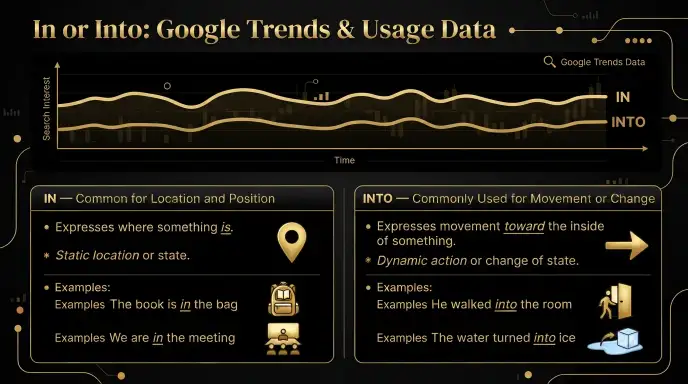
Search interest for it is naturally much broader because it is one of the most common English words and has many different meanings. It can describe place, time, condition, membership, and other ideas.
Into has a narrower range of common uses. Searches for in or into often come from people trying to understand the difference between location and movement.
Instead of treating these words as competing spellings, it is more useful to study their grammatical roles:
| Word | Main idea | Common use |
| in | Position | She is in the room. |
| into | Movement inside | She walked into the room. |
| in | Time | He arrived in May. |
| into | Change | The water turned into ice. |
| into | Interest | She is into music. |
The usage distinction is also reflected in major English learner references. Cambridge identifies in with position and into with movement, while noting several additional uses of into.
In or Into Comparison Table
| Feature | In | Into |
| Position | Yes | Usually no |
| Movement inside | Sometimes, depending on the verb | Yes |
| Shows location | Yes | Usually shows direction |
| Shows change | No | Yes |
| Shows interest | No | Yes |
| Used for time | Yes | No |
| Example | The dog is in the house. | The dog ran into the house. |
The easiest rule is:
In = where something is.
Into = where something moves.
FAQs About In or Into
1. What is the main difference between in and into?
It usually describes a position or location. Into usually describes movement from outside to inside.
2. Is “in the room” correct?
Yes. Use it when someone or something is already inside the room.
3. Is “walked into the room” correct?
Yes. Walking into the room shows movement from outside the room to the inside.
4. Can I use “in” instead of “into”?
Sometimes. With verbs such as put, both forms can be possible:
- Put it in the box.
- Put it into the box.
The exact choice depends on the sentence and the meaning you want to stress.
5. Is “into” always about movement?
No. Into can also show change, interest, involvement, division, or a subject of investigation.
Examples include:
- turn into
- be into music
- divide into groups
- an investigation into the issue
6. Is “in to” the same as “into”?
No. Into is normally one word when it is the preposition showing movement or another related meaning. It can be two separate words with separate grammatical roles.
7. Is there a British or American difference between in and into?
No. The spelling is the same in British and American English. The main issue is choosing the correct word for the meaning.
Conclusion
Understanding in or into is easier when you focus on the difference between position and movement. It usually tells us that someone or something is already inside a place, container, area, or situation.
For example, “The keys are in the drawer” describes their location. Into, on the other hand, often shows movement toward the inside, as in “She put the keys into the drawer.”
The two words can sometimes be used with the same verb. For example, both “Put the book in the bag” and “Put the book into the bag” can be correct. The choice may depend on how strongly you want to show the movement or placement.
Remember the simple rule: in describes position, while into often describes movement or change. Also remember that into has other uses, such as showing interest or transformation.
There is no British or American spelling difference between these words, so the main task is understanding their meaning in context.
Once you learn this basic difference, choosing between in and into becomes much more natural in everyday speech, emails, school writing, and formal English.
Related Word!

I’m Taylor Brooks, a grammar enthusiast who loves making English writing clearer, simpler, and more accurate. I create helpful grammar tips and practical tools to make writing with confidence easier for everyone.






2 thoughts on “In or Into: Which One Should You Use?”