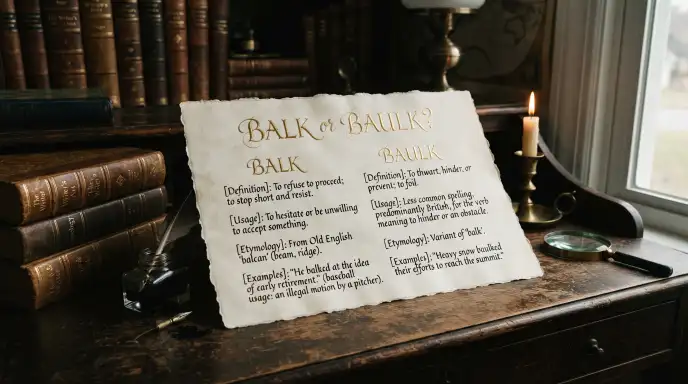
Wondering whether “balk or baulk” is the correct spelling? Both mean to hesitate or resist, but “balk” is common in American English, while “baulk” is preferred in British English.
If you are unsure if to write balk or baulk, both spellings are correct. The main difference is regional: balk is the standard spelling in American English, while baulk is especially common in British English.
Oxford lists baulk as British English and balk as British and North American English, while Cambridge likewise identifies baulk as the UK form.
The two forms have the same core meaning. They can describe someone who is unwilling to do something, hesitates because of difficulty, or, in a different sense, a horse that suddenly refuses to move or jump.
So which should you use? The safest choice is to match the spelling to your audience and your chosen style of English.
Quick Answer
Balk and baulk are two spellings of the same word. Balk is the usual spelling in American English, while baulk is especially associated with British English. Both mean to hesitate, resist, or be unwilling to do something.
Examples:
- US: She balked at the high price.
- UK: She baulked at the high price.
- Both: The horse balked at the fence.
Neither spelling is automatically wrong. The important thing is to stay consistent with the regional English you are using.
What Does Balk or Baulk Mean?
Balk and baulk are verbs that commonly mean to hesitate or refuse to do something because you find it difficult, unpleasant, costly, or undesirable.
For example:
The customer balked at the price.
This means the customer was reluctant to accept the price.
The word can also describe a horse that stops suddenly and refuses to move forward or jump. Oxford lists this as another established sense of the verb.
Common meanings
| Meaning | Example |
| To hesitate or resist | She balked at the idea. |
| To be unwilling to do something | He baulked at paying the extra fee. |
| A horse refuses to move or jump | The horse balked at the fence. |
| In baseball, to make an illegal pitching motion | The pitcher was called for a balk. |
The word can also appear as a noun. Cambridge lists balk as a noun for a rough, thick piece of wood and for a baseball action.
The Origin of Balk and Baulk
The history of balk/baulk helps explain why the word has several meanings.
Oxford traces back to late Old English, from Old Norse bálkr, meaning a partition. Its early sense referred to an unploughed ridge of land. Over time, the word developed meanings connected with an obstacle, mistake, hesitation, and being prevented from doing something.
This development helps explain the modern idea of someone “balking” at something. The person encounters an obstacle, real or figurative, and hesitates or resists.
The spelling later developed into the two forms seen today:
- balk became the usual American form.
- baulk remains strongly associated with British English.
The pronunciation is generally the same for the two spellings within the same variety of English. Cambridge gives UK pronunciation around /bɔːk/ and US pronunciation around /bɑːk/.
British English vs American English
The biggest difference between balk and baulk is spelling preference rather than meaning.
| Feature | British English | American English | Example |
| Preferred spelling | baulk | balk | She baulked/balked at the cost. |
| Alternative | balk is also used | baulk is uncommon | Both forms are understood. |
| Meaning | Same | Same | To hesitate or resist |
| Past tense | baulked | balked | He baulked/balked at the idea. |
| ing form | baulking | balking | She was baulking/balking at the proposal. |
Oxford specifically labels baulk as British English while noting balk as a British and North American form.
Cambridge follows the same broad pattern, marking baulk as the UK form and balk as the main entry.
Regional differences
If you are writing for a British audience, baulk may look more natural.
If your readers are mainly in the United States, balk is the better choice.
For international writing, either can work, but consistency matters more than choosing one spelling universally.
Style guides and publishing
Publishers, newspapers, universities, and organizations often follow a particular variety of English. If a publication uses British English, use baulk where that style calls for it. If it uses American English, use balk.
The key rule is simple:
Follow the style of the publication rather than switching between forms.
Which Version Should You Use?
United States
Use balk.
Example:
Many buyers balk at unexpected fees.
This is the normal American spelling. Cambridge’s American entry uses balk, while Oxford lists balk as a North American form.
United Kingdom
Use baulk if you want the distinctly British spelling.
Example:
Many buyers baulk at unexpected fees.
However, balk is also used in British English, so seeing balk in a British text does not automatically make it incorrect. Oxford explicitly recognizes both forms.
Canada
Canadian English can use influences from both British and American spelling traditions. For a Canadian publication, follow its house style.
If no house style exists, balk is a practical choice for a general audience because it is widely recognized internationally.
Australia
Australian English generally follows many British spelling conventions, so baulk may be preferred in formal British style usage.
Again, the publication’s own style guide should take priority.
International writing
For a global audience, balk is often the simpler choice because it avoids an extra letter and is widely recognized.
But if your website or publication consistently uses British English, keep baulk.
Academic writing
Use whichever spelling matches your institution, journal, or required style guide.
Do not switch between balk and baulk simply to vary your writing.
Business writing
Consistency is the main concern.
For US business writing:
The client may balk at the additional cost.
For UK business writing:
The client may baulk at the additional cost.
Common Mistakes
Mistake 1: Treating one spelling as completely wrong
Incorrect assumption:
“Baulk is misspelled.”
Better understanding:
“Baulk is a British spelling of balk.”
Both forms are established English spellings.
Mistake 2: Mixing regional spellings
You might write:
The customer balked at the price, but later baulked at the contract.
If both words mean the same thing, this switch is unnecessary.
Better:
The customer balked at the price, but later balked at the contract.
Or, in British English:
The customer baulked at the price, but later baulked at the contract.
Mistake 3: Assuming the pronunciation changes
The spelling changes, but the main verb has essentially the same pronunciation within the relevant variety of English. Cambridge gives /bɔːk/ in UK English and /bɑːk/ in US English.
Mistake 4: Confusing “balk at” with a simple refusal
Balk often suggests hesitation, reluctance, or resistance.
For example:
She balked at paying $500 for a ticket.
This tells us that the price caused her to hesitate or resist. Cambridge defines the verb as being unwilling to do something or allow something to happen.
Memory tip:
Think of balk/baulk as hitting a mental or physical obstacle.
Everyday Examples

Emails
American English:
We expected some customers to balk at the additional charge.
British English:
We expected some customers to baulk at the additional charge.
Business writing
Investors may balk at the proposed cost.
The word works well when discussing prices, risks, proposals, or difficult decisions.
News headlines
Voters Balk at Proposed Tax Increase
British publications may instead use:
Voters Baulk at Proposed Tax Increase
Blogs
You might balk at the price at first, but the product lasts for years.
Social media
I nearly balked at the price, but the quality changed my mind.
Academic writing
Participants may balk at questions that appear too personal.
Academic writers should still follow the spelling conventions required by their institution or publication.
Daily conversation
I balked at the idea of driving six hours in one day.
The expression balk at is especially useful when describing reluctance.
Google Trends & Modern Usage
Searches for balk or baulk often come from people who encounter both forms and want to know if one is a spelling mistake.
The difference is mainly tied to regional English. Dictionary sources continue to recognize both spellings, with baulk particularly associated with British English and balk strongly established in American English.
There is no need to treat the two forms as different words in ordinary writing. They share the same main meaning and grammatical behavior.
The spelling you see will often tell you something about the variety of English being used.
Why do people search “balk or baulk”?
Common reasons include:
- Checking if baulk is a spelling mistake
- Writing for a British or American audience
- Editing an article for regional English
- Choosing between British and American spelling
- Checking the correct spelling of balked, baulked, balking, or baulking
- Understanding dictionary differences
The safest approach is to identify your audience first, then use the spelling that matches your chosen English variety.
Quick Comparison Table
| Version | Meaning | Correct? | Region | Example |
| balk | Hesitate or resist | Yes | US; also UK | She balked at the price. |
| baulk | Hesitate or resist | Yes | Especially UK | She baulked at the price. |
| balked | Past tense of balk | Yes | US; also UK | He balked at the proposal. |
| baulked | Past tense of baulk | Yes | Especially UK | He baulked at the proposal. |
| balking | ing form of balk | Yes | US; also UK | They are balking at the cost. |
| baulking | ing form of baulk | Yes | Especially UK | They are baulking at the cost. |
Balk vs Baulk: At a Glance
| Question | Answer |
| Are balk and baulk the same word? | Yes, in their main modern usage. |
| Is balk correct? | Yes. |
| Is baulk correct? | Yes. |
| Which is American? | Balk |
| Which is especially British? | Baulk |
| Do they have the same meaning? | Yes, in the relevant sense. |
| Do you need to use both? | No. Pick the form that matches your style. |
| Which is best for US readers? | Balk |
| Which is best for UK readers? | Baulk is a natural British choice. |
Key Takeaways
- Balk and baulk are both correct spellings.
- Balk is the standard American spelling.
- Baulk is especially associated with British English.
- Both forms can mean to hesitate, resist, or be unwilling.
- The pronunciation is closely related, with regional pronunciation differences.
- Use balk for US focused content.
- Use baulk when following a British spelling style.
- Do not switch between the two spellings without a reason.
- Always follow the publication’s house style when one exists.
- When writing for a global audience, consistency matters more than choosing one form as universally “correct.”
FAQs
Is “balk” or “baulk” correct?
Both balk and baulk are correct. Balk is the usual American spelling, while baulk is especially associated with British English. The two forms have the same main meaning when used as verbs, including the sense of hesitating or being unwilling to do something.
Is “baulk” British or American?
Baulk is especially British. Oxford labels baulk as British English and notes balk as a British and North American form. Therefore, baulk is not an American spelling preference, although American readers will generally understand it.
Is “balk” American or British?
Balk is strongly associated with American English, but it is not limited to the United States. Oxford recognizes balk in both British and North American English. Cambridge also uses balk as its main entry and identifies baulk as the UK form.
What does “balk at” mean?
Balk means to hesitate, resist, or be unwilling to do something. For example, “She balked at the price” means that she was reluctant to accept or pay the price. The expression is common in both British and American English.
Is “baulked” a correct word?
Yes. Baulked is the past tense and past participle of baulk. In American English, the corresponding form is usually balked. Oxford lists both forms according to the spelling used.
Is “baulking” correct?
Yes. Baulking is the ing form of baulk and is especially associated with British English. The American spelling is balking. Both forms follow the spelling of the base verb.
Does “balk” have other meanings?
Yes. Besides meaning to hesitate or resist, balk can refer to a horse suddenly refusing to move or jump. In baseball, a balk is also a specific illegal pitching action. Cambridge and Oxford both list additional senses.
Should I use “balk” or “baulk”?
Neither spelling is inherently better for. Use the spelling that matches your target audience and the variety of English used on your website. If your content targets US readers, balk is appropriate. If it targets UK readers, baulk may fit better. You can mention both naturally when the topic is spelling comparison.
Can I use “balk” in British English?
Yes. Balk is not simply an American only spelling. Oxford explicitly lists balk as a British and North American form, while baulk is marked as British English.
Which spelling should international writers use?
International writers should follow the English variety used by their audience, organization, or publication. If there is no specific style requirement, balk is a clear and widely recognized choice. Most importantly, remain consistent throughout the document.
Conclusion
So, balk or baulk? The answer is that both are correct. The difference is mainly one of regional spelling and style.
Use balk when writing in American English. Use baulk when following a British English style. British English can also use balk, so baulk should not be treated as the only correct British form.
Both spellings share the same main meaning: to hesitate, resist, or be unwilling to do something. The word can also describe a horse that refuses to move or jump, and balk has additional technical uses, including baseball.
The best writing choice is not about deciding which spelling is “better.” It is about matching your audience and keeping your spelling consistent.
Read More About!

I’m Taylor Brooks, a grammar enthusiast who loves making English writing clearer, simpler, and more accurate. I create helpful grammar tips and practical tools to make writing with confidence easier for everyone.




2 thoughts on “Balk or Baulk: Which Spelling Is Correct?”