
Wondering whether “optimize or optimise” is the correct spelling? Both are correct, with “optimize” used mainly in American English a
If you are wondering if optimize or optimise is correct, both spellings are correct, but optimize is the American English form while optimise is usually the British English form.
The two words have the same meaning: to make something as good, effective, or efficient as possible.
People often search for “optimize or optimize” because English spelling changes between countries. This can be confusing when writing emails, articles, business documents, academic papers, or website content for an international audience.
Choosing the right form is usually not about grammar; it is about following the English style expected by your readers.
The difference is especially noticeable in professional and digital writing. American websites commonly use optimize, while British English commonly uses optimise.
Dictionaries such as Cambridge and Oxford recognize the distinction and list optimise as the British form.
This guide explains the meaning, history, regional spelling, common mistakes, examples, and practical advice for choosing between optimize and optimize
Quick Answer
Optimize and optimize mean the same thing.
- Optimize → American English
- Optimise → British English
- Meaning → to make something as good, effective, or efficient as possible
Examples
American English:
We need to optimize the website for mobile users.
British English:
We need to optimize the website for mobile users.
Neither spelling is inherently wrong. The best choice depends on your audience and the English style you are following.
Definition and Meaning of Optimize or Optimise
Clear Definition
To optimize or optimise means to improve something so that it works as effectively or efficiently as possible. Cambridge defines optimize as making something “as good as possible,” while Oxford also includes the idea of using something in the best possible way.
Simple Meaning
In simple terms:
Optimize/optimise = make something better or work as well as possible.
For example:
- optimize a website → make the website work better
- optimize a process → make the process more efficient
- optimize resources → use resources in the best way
- optimize performance → improve performance
Context and Usage
The word is common in technology, business, marketing, engineering, science, and everyday writing.
For example:
- Technology: optimize software
- Business: optimise a workflow
- Engineering: optimize performance
- Finance: optimize spending
Oxford notes that optimize is also used in computing for changing data or software so it works more efficiently or suits a particular purpose.
Different Meanings
The basic meaning stays the same across contexts, but the object being improved can change.
For example:
- Optimize a website → improve its performance or search visibility.
- Optimize a process → make the process more efficient.
- Optimize resources → use available resources effectively.
- Optimize software → modify it to improve efficiency or performance.
The Origin of Optimize or Optimise
The word comes from Latin optimus, meaning “best.” Oxford traces optimize to the early 19th century, while Merriam Webster records its first known use in the modern English sense in 1941.
The spelling difference developed from regional English conventions. American English generally favors ize, while British English often uses words such as optimise. Merriam Webster specifically identifies optimise as the British spelling of optimize.
This is part of a larger pattern in English:
| American English | British English |
| optimize | optimise |
| organize | organise |
| realize | realise |
| recognize | recognise |
The difference is mainly spelling, not meaning.
British English vs American English Spelling
The easiest rule is to match the spelling to your chosen English variety.
| English variety | Preferred spelling | Example |
| American English | optimize | We optimize website performance. |
| British English | optimise | We optimize website performance. |
| Australian English | optimise is common | We optimize the process. |
| New Zealand English | optimise is common | We optimize resources. |
| International content | Either, but stay consistent | Choose one style. |
Cambridge lists optimize as the main form and notes that British English usually uses optimise.
Which Spelling Should You Use?
Your audience should determine your choice.
For a US Audience
Use optimize.
Example:
Our team will optimize the website before launch.
For a UK Audience
Use optimise.
Example:
Our team will optimize the website before launch.
For Commonwealth Audiences
Optimise is often appropriate in British style English, although actual usage can vary by country and context.
For Global Websites
Choose the spelling that matches your main target audience. Most importantly, be consistent.
If your website follows American English, use optimize throughout the page. If it follows British English, use optimise throughout.
do not automatically assume that one spelling is always better. Search behavior varies by location and audience. A UK focused website should generally consider the spelling its UK readers are most likely to use.
Common Mistakes with Optimize or Optimise
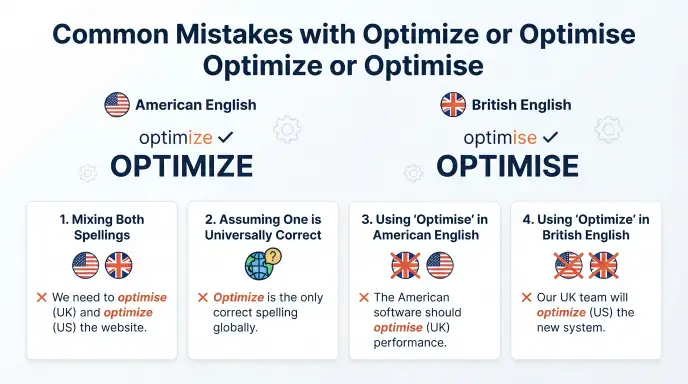
1. Thinking One Spelling Is Wrong
Incorrect assumption:
“Optimise is misspelled.”
Correction:
Both optimize and optimise are accepted English spellings. Optimise is the British spelling.
2. Mixing Spelling Styles
A document can look inconsistent if it uses optimize in one paragraph and optimise in another without a reason.
Better:
We optimize the website and optimize the checkout process.
Or, in British English:
We optimize the website and optimize the checkout process.
3. Changing the Meaning
The spelling does not change the meaning.
Both forms mean making something as good or effective as possible.
4. Choosing Based Only on a Spellchecker
Some spellcheckers use American English by default. A red underline does not necessarily mean the British form is wrong.
Check the language setting before changing the word.
Optimize or Optimise in Everyday Examples
In Emails
US English:
Please optimize the report before sending it.
UK English:
Please optimize the report before sending it.
In News
US style:
The company plans to optimize its production process.
UK style:
The company plans to optimize its production process.
In Social Media
US style:
Here are five ways to optimize your website.
UK style:
Here are five ways to optimize your website.
In Formal Writing
US style:
The study examined methods to optimize resource use.
UK style:
The study examined methods to optimize resource use.
The important point is consistency. The word should match the spelling system used by the rest of the document.
Optimize or Optimise :Google Trends & Usage Data
Search and usage patterns show a strong regional difference between the two spellings. Current usage references consistently describe optimize as the dominant American form and optimise as the preferred British form.
Some usage datasets also show that the difference is not absolute. For example, optimize appears in countries where British spelling is traditionally taught, especially in technology and digital contexts.
This reflects the strong international influence of American English in software,, and online publishing.
For, this means that location and search intent matter more than simply choosing the spelling that looks more familiar.
A website targeting US readers may naturally focus on optimize, while a UK focused website may prefer optimise.
Comparison Table: Optimize vs Optimise
| Feature | Optimize | Optimise |
| Main variety | American English | British English |
| Meaning | Make as good/effective as possible | Make as good/effective as possible |
| Ending | ize | ise |
| US usage | Preferred | Less common |
| UK usage | Less common | Usually preferred |
| Computing | Common | Common |
| Common globally | Important for UK focused content | |
| Correct spelling? | Yes | Yes |
Usage data should be treated as a guide rather than an absolute rule because people in different countries may use both forms.
FAQs
1. Is optimize or optimise correct?
Both are correct. Optimize is the American English spelling, while optimise is the usual British English spelling.
2. Does optimize mean the same as optimise?
Yes. They have the same meaning: to make something as good, effective, or efficient as possible.
3. Which spelling should I use in the US?
Use optimize for American English.
4. Which spelling should I use in the UK?
Use optimise for British English.
5. Is optimizing a misspelling?
No. Optimise is a standard British spelling of optimize.
6. Which spelling is better for?
Use the spelling that fits your target audience and regional search behavior. For US audiences, use optimize; for UK audiences, optimise is generally more natural.
7. Can I use both spellings in one article?
You can, but it is usually better to choose one spelling and use it consistently unless you are specifically discussing the difference between them.
Conclusion
Optimize and optimise are both correct spellings of the same word. The main difference is regional: optimize is the preferred American English form, while optimise is usually preferred in British English. Dictionaries such as Cambridge, Oxford, and Merriam Webster recognize this distinction.
The word means to make something as good, effective, or efficient as possible. It is widely used in business, technology, science, engineering, and everyday communication.
When choosing between the two, think about your readers first. If you are writing for Americans, choose optimize.
If you are writing for British readers, choose optimise. For international websites, select the spelling that best matches your primary audience and maintain that choice throughout your content.
Most importantly, do not treat one spelling as correct and the other as incorrect. The difference is a matter of regional English style, not meaning. Consistency is what makes your writing look professional.
Meta description: Optimize or optimise explained: learn the meaning, US and UK spelling differences, usage rules, examples,advice, and common mistakes.
Related siang!

I’m Taylor Brooks, a grammar enthusiast who loves making English writing clearer, simpler, and more accurate. I create helpful grammar tips and practical tools to make writing with confidence easier for everyone.





1 thought on “Optimize or Optimise: Which Spelling Should You Use?”