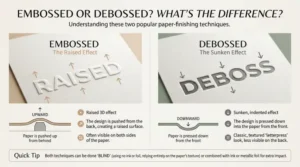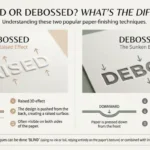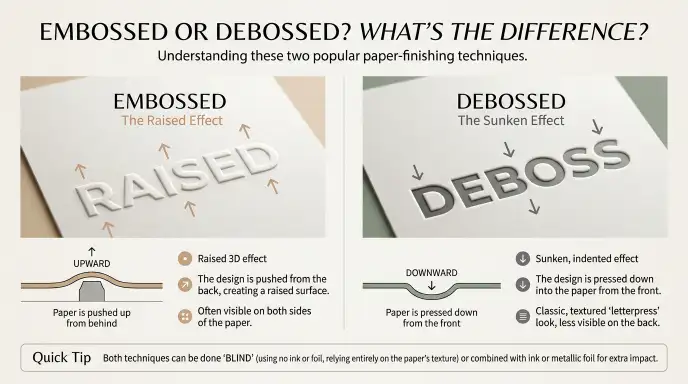
Embossed or debossed describes two ways of adding designs, letters, or logos to a surface. Embossing raises a design above the surface, while debossing presses it below the surface.
Both techniques are used in packaging, printing, business cards, and product design to create different looks and textures.
The main difference is simple: embossing raises the design above the surface, while debossing presses it below the surface. Both techniques are common in printing, packaging, leather goods, stationery, book covers, and product design.
The two terms are easy to confuse because they describe similar finishing methods. Both can create a tactile design without simply printing an image with ink. The difference becomes clear when you touch the finished surface or look at it from the side.
This guide explains what embossed and debossed mean, where the terms come from, how they differ, and how to choose the right word for different situations.
You will also see practical examples from business cards, invitations, packaging, books, leather products, and everyday writing.
Embossed or Debossed: Quick Answer
The easiest way to remember the difference is to think about direction.
- Embossed: the design comes up from the surface.
- Debossed: the design goes down into the surface.
- Embossing: creates a raised or relief effect.
- Debossing: creates a recessed or sunken effect.
Examples
- Embossed business card: The company name is raised so you can feel the letters.
- Debossed leather wallet: The brand name is pressed into the leather.
- Embossed book cover: The title stands slightly above the cover.
Both methods can be used on materials such as paper, cardstock, leather, metal, packaging materials, and other suitable surfaces.
What Does Embossed Mean?
Embossed describes something that has been given a raised design or pattern. The design stands above the surrounding surface, creating a three dimensional effect.
Cambridge Dictionary defines emboss as decorating an object, especially with letters, using tools that create a raised mark. Collins similarly describes embossing as creating designs that are raised above the surface.
Embossing can be used for both decoration and identification. A company may emboss its logo on stationery, while a designer may emboss a pattern on a greeting card.
Common embossed items
- Business cards
- Wedding invitations
- Book covers
- Leather notebooks
- Product packaging
- Certificates
- Stationery
- Labels
- Metal products
- Decorative paper
An embossed design is usually noticeable by touch. If you run your finger over the design and it feels higher than the surrounding area, it is likely embossed.
Example sentences
- The company name was embossed on the leather cover.
- Her initials were embossed on the notebook.
- The invitation had an embossed floral pattern.
What Does Debossed Mean?
Debossed describes a design that has been pressed or indented into a surface. Instead of rising above the material, the design creates a recessed area.
Dictionary.com defines deboss as indenting a figure or design into a surface. Collins gives a similar definition and describes it as pressing a design onto a surface to create a sunken area.
Debossing is often chosen when a designer wants a quieter, more subtle appearance.
Common debossed items
- Leather wallets
- Leather notebooks
- Business cards
- Packaging
- Book covers
- Promotional products
- Paper goods
- Labels
- Wooden products
- Custom stationery
Example sentences
- The brand name was debossed into the leather.
- The notebook had a debossed logo on its cover.
- The company chose a debossed design for its packaging.
The key idea is simple: debossing creates a depression in the material.
The Origin of Embossed and Debossed
The history of these words helps explain why they look and sound related.
The verb emboss dates back to the late 14th century. The word came into English through French forms related to boce, meaning a knob, swelling, or raised mass. Its early sense involved decorating something with raised work.
Deboss is a much more transparent formation. Dictionaries trace it to de + boss, with the meaning of pressing a design inward or creating an indentation.
The two words therefore developed around opposite physical effects:
- Emboss: create something raised.
- Deboss: create something recessed.
The terms are now widely used in printing, packaging, product design, crafts, and manufacturing.
British English vs American English
Unlike words such as colour/color or centre/center, embossed and debossed do not normally have separate British and American spellings.
The words are used in both varieties of English. The main difference you may notice is pronunciation, not spelling.
| Term | British English | American English | Example |
| Embossed | Embossed | Embossed | The logo is embossed. |
| Debossed | Debossed | Debossed | The logo is debossed. |
| Embossing | Embossing | Embossing | Embossing adds a raised effect. |
| Debossing | Debossing | Debossing | Debossing creates a recessed effect. |
Cambridge and Collins list emboss as a standard English word in both UK and US usage, while Collins also lists deboss in British and American English.
Regional differences
There is no major regional rule that says one term belongs to the United States and the other belongs to the United Kingdom. Designers, printers, manufacturers, and writers in both regions can use both words.
The important issue is using the correct term for the physical result.
Style guides and publishing
In professional writing, choose the word that accurately describes the finished product. If the letters stand above the surface, use embossed. If they are pressed into the surface, use debossed.
Consistency also matters. If a product description calls a recessed logo “embossed,” customers may expect a raised effect and become confused.
Which Version Should You Use?
There is no single choice between embossed and debossed because they describe different techniques.
Choose the word based on the physical design.
United States
Both terms are standard in American English.
- Raised design = embossed
- Recessed design = debossed
United Kingdom
The same distinction applies in British English.
- Raised design = embossed
- Recessed design = debossed
Canada
Canadian writers can use both terms. Follow the terminology used by the printer, manufacturer, or design professional when describing a specific project.
Australia
Both words can be used in Australian English. The correct choice depends on the surface effect rather than the region.
International writing
For an international audience, explain the difference clearly if the reader may not know the terms. A short phrase such as “raised logo” or “recessed logo” can make the meaning instantly clear.
Academic writing
In academic or technical writing, use embossed and debossed only when they accurately describe a physical process or result. Define the terms the first time they appear if your audience may not know them.
Business writing
Product descriptions should be especially precise. Saying “debossed leather logo” tells the customer that the logo is pressed into the leather, while “embossed leather logo” indicates a raised effect.
Embossed vs Debossed: Main Differences
| Feature | Embossed | Debossed |
| Surface effect | Raised | Recessed |
| Direction | Moves outward | Moves inward |
| Texture | Raised to the touch | Indented to the touch |
| Visual style | More prominent | More subtle |
| Common materials | Paper, leather, metal, packaging | Leather, paper, packaging, wood |
| Common use | Logos, invitations, covers | Logos, leather goods, packaging |
| Example | Raised initials on a card | Pressed initials on a wallet |
The biggest difference is depth. Embossing pushes or forms the design upward, while debossing creates a depression.
Common Mistakes
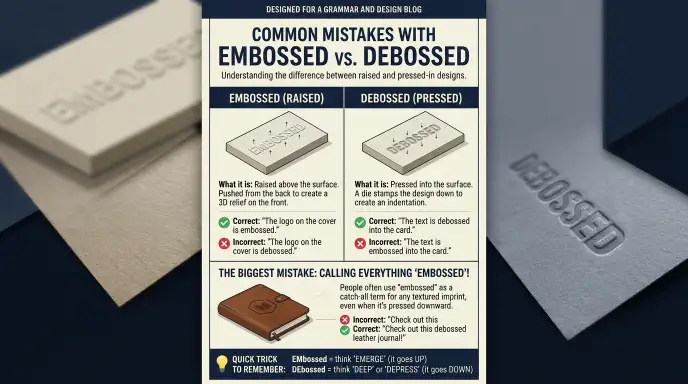
Mistake 1: Using embossed for every raised looking design
Not every decorative mark is embossed. The term specifically describes a raised design or relief effect.
Incorrect:
“The logo was debossed above the surface.”
Correct:
“The logo was embossed above the surface.”
Why?
A design above the surface is raised, so embossed is the correct term.
Memory tip: Think emboss = up.
Mistake 2: Calling a recessed logo embossed
This is one of the most common mix ups.
Incorrect:
“The brand name is embossed into the leather.”
Correct:
“The brand name is debossed into the leather.”
Why?
The words are pressed below the surface, so the effect is debossed.
Memory tip: Think deboss = down.
Mistake 3: Confusing embossing with printing
A printed design may look bold or colorful, but printing alone does not necessarily create a raised or recessed surface.
For example:
- Ink printed on paper = printed
- Raised letters = embossed
- Pressed in letters = debossed
Mistake 4: Confusing embossing with engraving
Engraving and debossing can both create marks below a surface, but they are not always the same process.
Engraving commonly involves cutting or removing material, while debossing describes a recessed design created by pressing or forming the surface.
Everyday Examples
The difference becomes easier to understand when you see how the words work in real sentences.
Emails
“The supplier confirmed that our company logo will be embossed on the folders.”
This tells the reader that the logo will have a raised effect.
“The initials will be debossed on the leather covers.”
Here, the initials will be pressed into the material.
Business Writing
“Please approve the embossed logo before production begins.”
“The new packaging uses a debossed brand mark.”
Both sentences use the terms correctly because they describe different surface treatments.
News Headlines
A headline might say:
“Luxury brand introduces embossed packaging.”
The word embossed tells readers that the packaging has a raised design.
Blogs
“An embossed wedding invitation adds texture without relying on bright colors.”
A blog about design may also say:
“Debossed leather gives a notebook a clean and understated look.”
Social Media
“Our new notebooks feature a debossed logo on the front cover.”
Or:
“The new invitation collection uses elegant embossed lettering.”
Academic Writing
“The sample contains an embossed pattern that can be identified by touch.”
A technical discussion may instead state:
“The surface contains a debossed region around the central mark.”
Daily Conversation
“Is that logo embossed?”
“No, it is debossed. You can feel it going into the cover.”
These simple questions show the difference clearly.
Google Trends & Modern Usage
Search interest can change over time, but exact trend data should not be assumed without checking a current trends dataset.
The practical distinction between the terms is more useful than guessing which word is searched more often.
People commonly search for embossed or debossed because the two techniques are easy to confuse.
A person ordering business cards, packaging, leather goods, or invitations may need to know which option creates a raised surface and which creates a recessed one.
Modern design and printing tools also use the same distinction. For example, HP documentation describes emboss and deboss effects in terms of raised and recessed depth.
Embossing and related finishing methods remain part of modern print embellishment. Adobe describes embossing as one of several techniques used to add tactile and dimensional effects to printed products and packaging.
The safest rule is simple: describe the physical effect rather than relying on regional usage or appearance alone.
Quick Comparison Table
| Version | Meaning | Correct? | Region | Example |
| Embossed | Raised design | Yes | US, UK, Canada, Australia, International | The title is embossed. |
| Debossed | Recessed design | Yes | US, UK, Canada, Australia, International | The logo is debossed. |
| Embossing | Process that creates a raised design | Yes | International | The card uses embossing. |
| Debossing | Process that creates a recessed design | Yes | International | The cover uses debossing. |
Embossed or Debossed for Different Materials
The best choice can also depend on the material and the look you want.
Paper and Cardstock
Embossing is popular for invitations, certificates, business cards, and stationery because raised lettering can create a clear tactile effect.
Debossing can give paper products a quieter and more modern appearance.
Leather
Both techniques are common on leather products.
An embossed leather logo stands out from the surface. A debossed logo is pressed into the leather and often has a more understated appearance.
Packaging
Packaging designers may use embossing or debossing to make a brand name or pattern feel more distinctive.
These techniques can be combined with other finishing methods, such as foil or special coatings. Adobe lists embossing among print embellishment techniques used for visual and tactile effects.
Metal
Embossing can create raised metal designs, labels, panels, and decorative surfaces. The exact manufacturing method depends on the material and product.
Key Takeaways
- Embossed means a design is raised above the surface.
- Debossed means a design is pressed or indented into the surface.
- Both terms are correct, but they describe opposite surface effects.
- The words are used in both British and American English.
- Embossed and debossed are not simply spelling variants.
- A raised company logo is embossed.
- Printing a design with ink does not automatically make it embossed or debossed.
- Use the term that matches the actual physical result.
- A simple memory trick is emboss = up and deboss = down.
FAQs
What is the difference between embossed and debossed?
Embossed means the design is raised above the surface, while debossed means the design is pressed below the surface.
Both techniques create a physical texture, but they move in opposite directions. If you can feel the design standing up from the material, it is embossed. If you feel an indentation, it is debossed.
Is embossed raised or indented?
Embossed means raised. An embossed letter, logo, or pattern stands above the surrounding surface.
You can usually feel the design by running your finger over it. This effect can be created on materials such as paper, leather, metal, and packaging materials.
Is debossed raised or recessed?
Debossed means recessed or indented. The design is pressed into the material rather than pushed above it.
A debossed logo on a leather notebook, for example, creates a sunken mark that you can feel with your fingers.
Is debossed the opposite of embossed?
Yes, in terms of the surface effect, debossing is essentially the opposite of embossing. Embossing creates a raised design, while debossing creates a recessed design.
The two terms are often discussed together because both describe methods for creating a tactile design on a surface.
Is embossed or debossed better?
Neither technique is automatically better. They create different results. Embossing can make a design stand out through a raised texture, while debossing can produce a more subtle recessed effect. The right choice depends on the material, design, purpose, and appearance you want.
Can a logo be both embossed and debossed?
Yes. A design can use raised and recessed elements together, depending on the manufacturing method and material.
For example, one part of a logo may be raised while another part is pressed inward. Combining the effects can create additional depth and contrast.
Are embossed and debossed the same as printed?
No. Printing normally adds ink, toner, or another visible layer to a surface. Embossing and debossing change the physical shape of the surface.
A product can also combine printing with embossing or debossing, but the terms describe different features.
Is embossing used only on paper?
No. Embossing can be used on many materials, including paper, cardstock, leather, metal, and packaging materials.
The exact process depends on the material and the equipment used. Cambridge describes embossing as creating raised marks on an object, especially letters or designs.
How can I remember embossed vs debossed?
Use the simple memory trick emboss = up and deboss = down. If the design comes up from the surface, it is embossed.
If it goes down into the surface, it is debossed. This shortcut makes the difference easy to remember when writing product descriptions.
Which term should I use for a leather logo?
Use embossed if the leather logo is raised above the surface. Use debossed if the logo is pressed into the leather.
Both terms are correct for leather products, so the physical result determines which word you should choose.
Conclusion
Embossed or debossed is not a choice between two spellings. The two words describe two different surface effects. An embossed design is raised, while a debossed design is recessed or pressed into the material.
Both terms are used in British and American English, so you do not need to change the word based on your audience’s country. Instead, look at the finished design and describe what it actually does to the surface.
For business cards, invitations, packaging, leather goods, books, and stationery, precise wording helps readers understand the product before they buy or order it.
If the logo rises above the material, call it embossed. If it sinks into the material, call it debossed.
The easiest rule to remember is: embossed goes up, debossed goes down.
Use that simple rule whenever you are writing a product description, discussing printing, or comparing finishing techniques. Once you remember the direction of the design, choosing the correct term becomes easy.
Learn the Meaning!

I’m Taylor Brooks, a grammar enthusiast who loves making English writing clearer, simpler, and more accurate. I create helpful grammar tips and practical tools to make writing with confidence easier for everyone.